You’re amazing at what you do but you don’t reach the right people
You've got a stand-out service, you know your craft inside and out... but somehow you're not reaching the right people. Or maybe you're not reaching people at all.
If that's you, here's where to start: get crystal clear on exactly who you're selling to. And I don't mean "women who want to feel better" clear. I mean specific. The more precise you can get, the easier it becomes not just to make money, but to actually help the people you want to help.
And maybe you want to be inclusive but I’m sorry to tell you that "everyone" is not a target market. When you try to speak to everyone, you end up speaking to no one, and your website, your content, your offers all end up sounding generic and forgettable. What you show doesn’t resonate and people don’t buy. Not because you're not good. Because you haven't decided who you're talking to yet.
Why Defining Your Ideal Client Actually Matters
This isn't just a branding exercise you do once and forget about. Knowing your ideal client (you can also see this mentioned as dream client or target audience) shapes SO MUCH in your business, including things you might not expect. It:
Guides your visual choices - colors, fonts, imagery, overall vibe all shift depending on who you're trying to attract
Improves your messaging - you stop writing to impress and start writing to connect. You know what to say in on your website, social media, emails… and that actually clicks with your dream client
Boosts conversion - people buy faster when they feel like you're speaking directly to them
Defines your website structure and flow - what they need to see first, second, and last changes based on who they are
Makes content creation so much easier - no more staring at a blank page wondering what to post
Gives you clearer positioning - you stand out because you're not trying to be everything to everyone
Saves your energy - you naturally start filtering out the clients who drain you and making more room for the ones who light you up
The Two Sides of Your Ideal Client
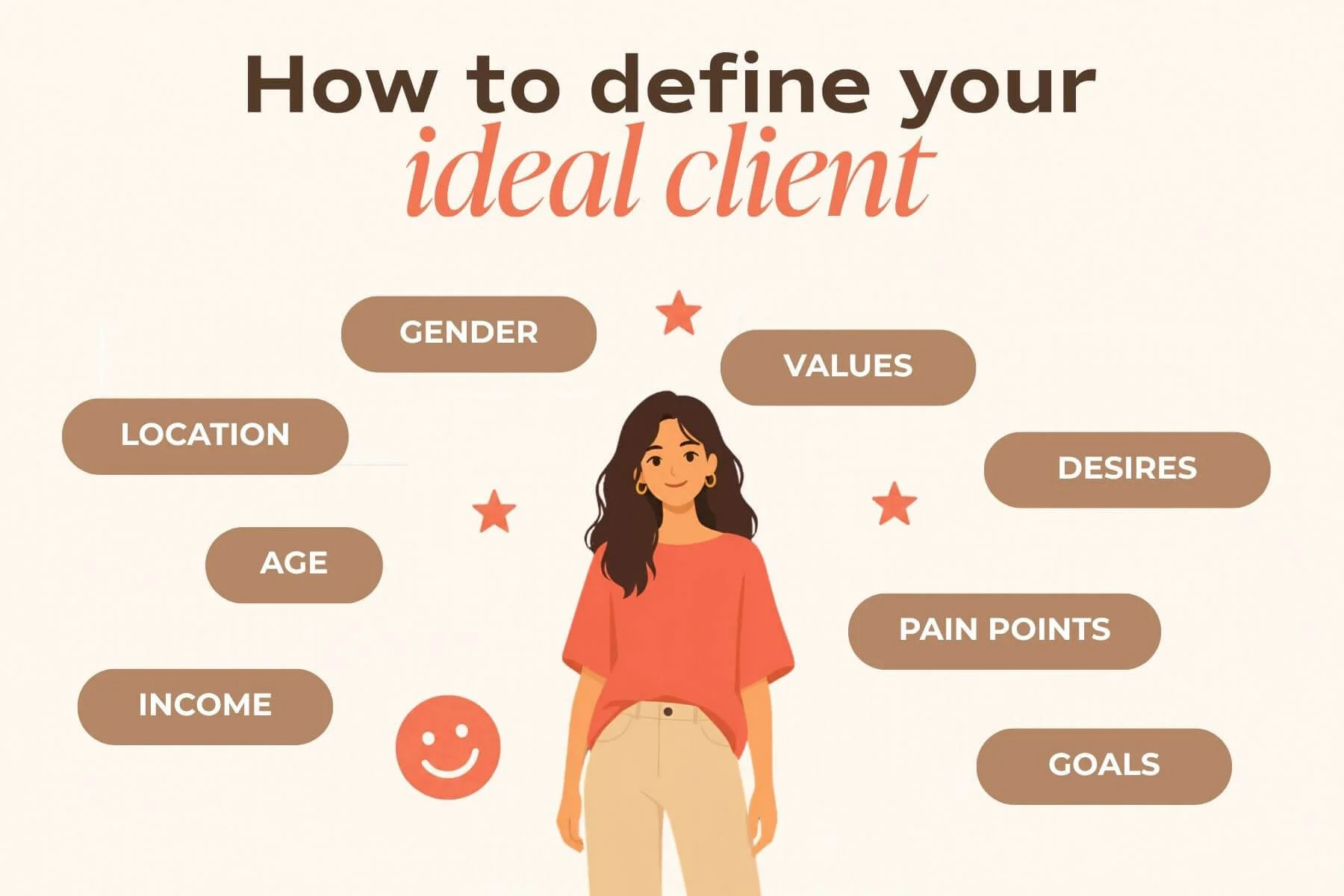
Ok, the next question is: How do I figure out who my ideal client actually is? How do you actually define this person? There are two main components to building out your ideal client: demographics and psychographics.
Demographics are the surface-level, factual details - the who and where. Think:
Location
Age range
Gender
Income or budget level
Occupation or industry
Life stage (new parent, business owner, recently retired, etc.)
Psychographics go deeper. This is where the real gold is, because this is what actually drives buying decisions. Think:
Pain points and frustrations
Desires and aspirations
Goals, both short and long-term
Values and beliefs
Interests and hobbies
What keeps them up at night
What they've already tried that hasn't worked
Demographics tell you WHO your ideal client is on paper. Psychographics tell you WHY they'll choose you. You need both, but if you only have time to nail one, start with the psychographics — that's what your messaging will actually hang on.
Once you have a clear picture of both, everything downstream gets easier. Your website and marketing materials stop being a guessing game and start being a conversation with one specific person who happens to need exactly what you offer.
Let's make this less abstract with a case study.
Example of Ideal Client
The Business: Fitness Coach
Sarah runs an online fitness coaching business helping women rebuild strength and confidence after childbirth.
The Ideal Client:
Demographics:
New moms, 3-18 months postpartum
Age 28-38
Married or partnered, first or second child
Household income comfortable enough to invest in themselves, but not unlimited - value matters
Limited free time, often training in 20-30 minute windows
Psychographics:
Wants to feel like herself again, not just "lose the baby weight"
Frustrated by generic fitness advice that ignores postpartum recovery (diastasis recti, pelvic floor, C-section healing)
Doesn't have time or energy for the gym, childcare is a barrier
Overwhelmed by meal prep on top of everything else
Craves community with other moms going through the same thing
Motivated by energy and confidence, not just aesthetics
Skeptical of "bounce back" culture - wants something that feels sustainable, not punishing
What to Do After Getting Clear on Your Target Audience
Now that I have an ideal client, what do I do with it?
Once you know exactly who you're talking to, the real work begins: building everything around that person. Your blog content, your social media posts, your email newsletters - all of it should speak directly to them. And your website is no exception. Your style, your images, your copy, all of it should be filtered through the lens of "would this resonate with my ideal client?"
Once you have a clear idea about your ideal client, every marketing decision becomes simpler. Take Sarah, for example:
What to write: Instead of generic "5 tips to lose weight" content, Sarah writes about diastasis recti recovery, 20-minute workouts that fit around nap schedules, or why "bouncing back" is the wrong goal altogether
What lead magnet to create: A free "10-Minute Core Reset" video series speaks directly to moms with no time and a real physical concern - not a generic 7-day meal plan that ignores postpartum recovery
What tone to use: Warm, encouraging, and judgment-free rather than intense or drill-sergeant-y — no "no excuses" gym talk, because that's not what her ideal client is looking for
What testimonials to feature: Stories from other new moms about regaining energy and confidence, not just before-and-after weight loss photos, since that's not the transformation Sarah's client actually wants
What offers to create: A program built around short, flexible sessions and simple meal guidance, not a rigid 5-day-a-week gym plan that assumes free time she doesn't have
Where to show up: Instagram and mom-focused Facebook groups over, say, LinkedIn or a platform built for a different audience entirely
How This Shows Up on Your Website
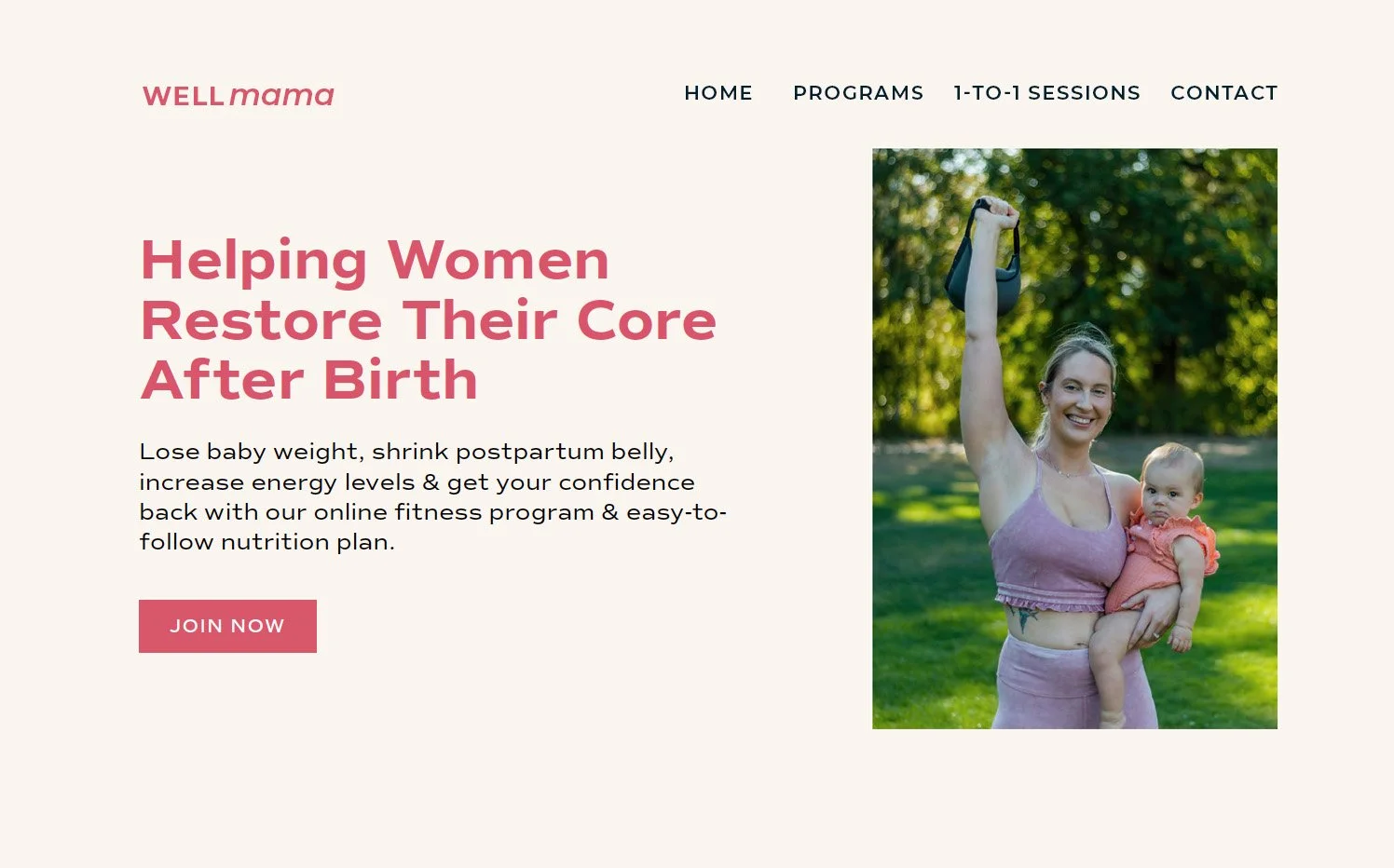
Now that we have clarity about Sarah’s ideal client, let’s see how this affects our design choices on her website, and more specifically, the hero section of her homepage.
The headline: "Helping Women Restore Their Core After Birth" - notice it doesn't say "lose weight fast" or "get your body back." It speaks to restoration, not erasure. That word choice matters because Sarah's ideal client isn't trying to return to who she was before, she's trying to feel strong in the body she has now. This headline was written for someone who's tired of fitness messaging that treats postpartum bodies as a problem to fix.
The paragraph: Notice how it stacks the exact outcomes she's after in order of what she cares about most: losing baby weight, yes, but also energy and confidence, and it closes on an easy-to-follow nutrition plan, directly answering the "I don't have time for meal prep" pain point. Nothing here is generic. Every phrase maps back to something specific in the ideal client.
The button: "Join now" is simple and clear call-to-action for someone already stretched thin and not looking for a complicated decision process.
The image: A new mom in workout outfit holding both a baby and a kettlebell isn't a stock-photo accident, it's doing double duty. It reflects the exact life stage of the ideal client (baby is still very present, she's not heading out to a gym alone) while also visually promising "this fits into your real life." If the photo showed a woman alone in a sleek studio gym, it would immediately signal "this isn't for someone like me" to a mom who can't get childcare for an hour-long session.
The color palette: The warm cream background isn't random either - it's soft and welcoming, setting a tone of warmth rather than intensity. The pink brings in energy, it's uplifting without being too in-your-face. Together they match exactly what Sarah's ideal client is looking for: strength without punishment, effort without harshness. A palette like this would feel completely wrong for a CrossFit-style audience chasing intensity, but for a new mom easing back into movement on her own terms, it feels like an invitation instead of a bootcamp.
FAQ
Q: How specific should I get when defining my ideal client?
A: More specific than feels comfortable. "Women who want to feel confident" is too broad to build anything on. "New moms who want to get back in shape without gym time or meal prep stress" gives you something to actually write to. If your description could apply to half the population, it's not specific enough yet.
Q: Can I have more than one ideal client, or should I pick just one?
A: You can have more than one ideal client, but it's usually smarter to start with one and get really specific before expanding. Trying to speak to two or three ideal clients at once from day one tends to water down your messaging. Nail one first, then layer in a second if it makes sense for your business.
Q: Where can I find my ideal clients?
A: Wherever they already spend time. Online this could be platforms, groups, hashtags, forums, or accounts they follow. But don't overlook offline options either - your ideal clients might be people your friends already know, or they might all go to the same coffee shop. They might show up at local events, farmers markets, or community classes. Word-of-mouth referrals often come from conversations and unexpected overlaps.
Q: What makes a website attract ideal clients?
A website that speaks their language, shows imagery they see themselves in or that appeals to them, and addresses their specific pain points and desires, not generic ones. Every choice, from headline to color palette to testimonials, should feel like it was made with them in mind.
Q: Why is my website attracting the wrong clients?
Usually it's because the messaging, visuals, or offers are too broad or aimed at a different person than who you actually want to work with. If your site speaks "to everyone", that includes people who aren't the right fit. Getting specific is the fix.
Need help with your website design?
Feel free to take a look at my website design service or simply reach out. I'd love to help! 🧡
